 Loading... Please wait...

Blog
Recent Posts
What is Gold?
Posted by on
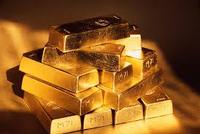
What is gold? Gold is an element (atomic number 79, symbol Au), like oxygen, only heavier and prettier. Pure gold, or 24 karat gold, is bright orange in color, and very soft. Too soft for most jewelry. So it is alloyed, or mixed with other metals, to make it more durable. In the U.S. most gold jewelry is 14k (14 karat), in Europe, 18k. What is 14 karat gold? 14 karat gold is 14 parts of pure gold, and 10 parts of other metals. They need to equal 24 parts, as pure gold is 24 karat, and if you take some away, you need to put an equal amount back. Always to equal 24 parts, even if there is only one part of pure gold.
I know it is a lot of numbers. But the math is pretty simple – like 18 karat gold is 18 parts of pure gold, and how many parts of other metal? Yep, 6 parts. So what are those other metals? That depends on the color of gold. For yellow gold, the metals are mostly copper and silver. If you use more copper, then you get red, pink, or rose gold. If you use more silver, you get green gold. Of course there are a gazillion variations, with no two alloys the same. (Remember, an alloy is just a mixture of different metals.) And each company has its’ own alloys, and colors.
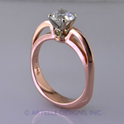
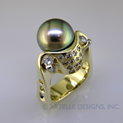
Rose Gold Green Gold
When someone says gold is dense, they don’t mean stubborn, they mean heavy. If you have the same exact ring in 10k, 14k, and 18k, the 18 karat ring will feel heavier. Why is that? Because it has more pure gold than the others, and pure gold is pretty dense, so a little feels pretty heavy. And 10 karat yellow gold is darker than 14 karat yellow gold, which is darker than 18 karat yellow gold, which has a nice lemony golden color.
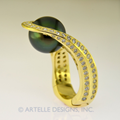
18k Yellow Gold
White gold is more difficult to make, because pure gold is bright orange, and does not like to be white. So in order to bleach it white, nickel is used. However, a lot of people are allergic to nickel, so other metals are used as well, such as palladium. Palladium is a platinum group metal, and is generally thought to be hypo-allergenic. White golds will yellow over time, because gold does not want to be white! It wants to be yellow! So it is often plated with rhodium, which is another platinum group metal. It is really, really white. But plating is a very thin layer, and it will eventually rub off, and the piece will need repeated re-plating. In between platings, it will not look so good, as the parts that rub will be yellowish, and the parts that don’t will be white. So I don’t recommend plating, unless absolutely necessary. Generally, polishing will do the same thing.
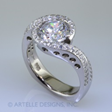
White Gold
Keep in mind that the karat affects the price, as the higher the karat, the more pure gold is in it, and the more it will cost. Because of its’ amazing malleability, and ductility, gold is perfect for making jewelry. It can be formed and re-formed, melted and re-melted. All of the gold we work with is recycled, and has been since 1986. We will even use the gold from your cherished heirlooms, to make new heirlooms, and pass that karma on to the next piece.
So in a nut-shell, like say a pistachio nut shell, that explains gold. If you want to know more, I know more. Please feel free to leave your comments and questions. You can do that here http://artelledesigns.com/contact-us/
So, what is platinum? Platinum is not gold. I will be explaining platinum in my next blog post. Stay tuned!